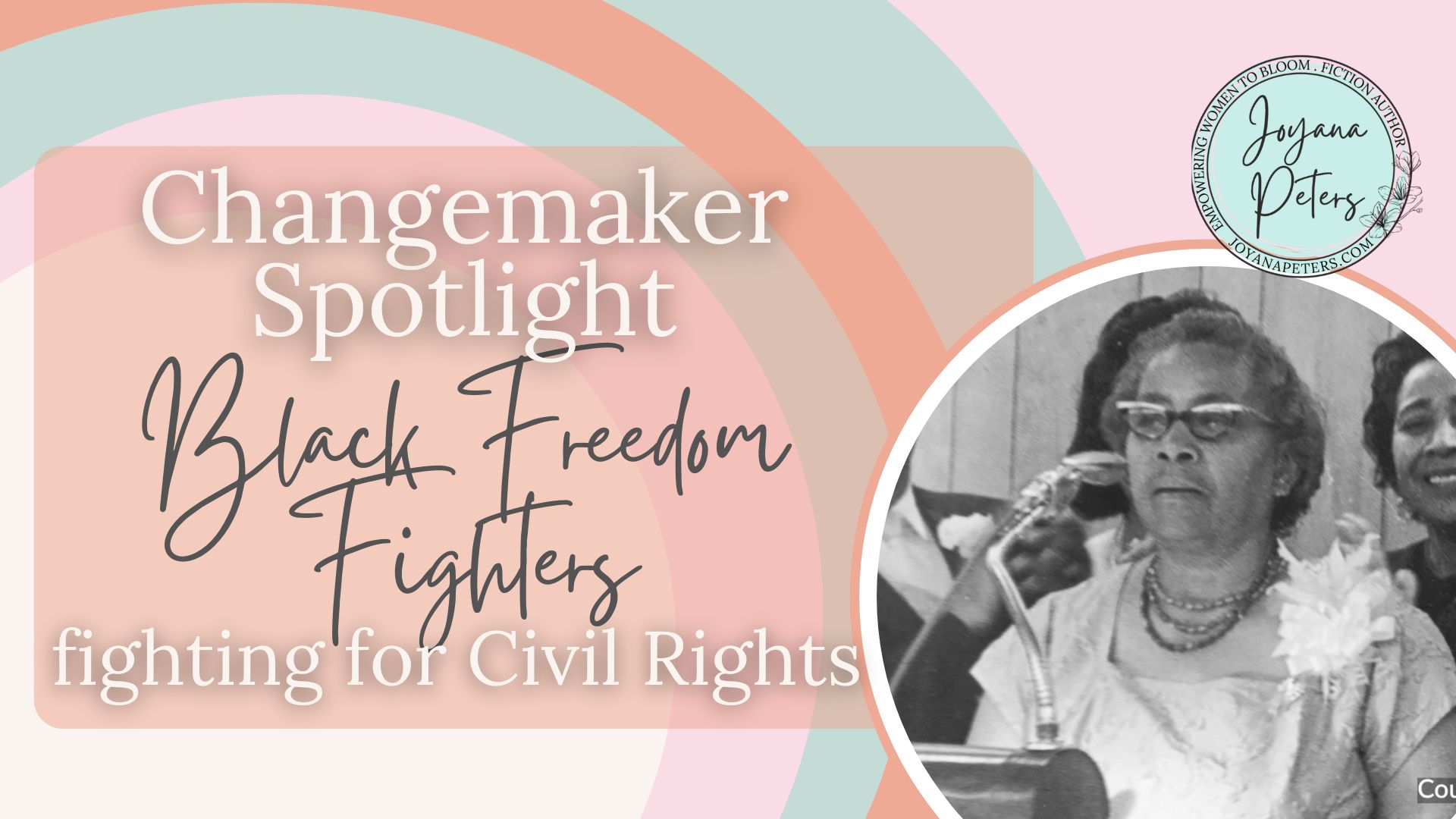
Black Freedom Fighters

Black Female Freedom Fighters

As an Amazon Associate I earn from qualifying purchases.

Let’s honor some of the courageous women who fought for civil rights!

Black Female Freedom Fighters

In honor of MLK Day, I wanted to write about the fight for civil rights and equality. But as so many things in history, I feel there is a lack of acknowledgement for some of the amazing women who contributed to this fight. So today, let’s shine a light on some amazing Black Female Freedom Fighters!

Septima Clark

Septima Clark was a public school teacher in South Carolina for thirty years. She was forced to relinquish her position in 1956 when she refused to renounce her involvement with the NAACP.

Believing literacy to be the key to political empowerment, she went on to set up workshops to teach others basic literacy skills, the rights and responsibilities of U.S. citizens and how to fill out voter registration forms.

She continued teaching and advocating for civil responsibilities for the rest of her life. She taught and developed curriculum at key places like the Highlander Folk School for social advocacy, the Southern Christian Leadership Conference and the American Field Service.

In 1975, she was elected to the South Carolina School Board. She received a letter of apology the following year from the South Carolina governor and got her pension reinstated.

In 1979, she was recognized by President Jimmy Carter and given a Living Legacy Award and published an autobiography about her involvement and journey with the Civil Rights Movement. You can check it out below!

Amelia Boynton Robinson

Amelia Boynton Robinson

Amelia Boynton Robinson was an activist leader in the American Civil Rights Movement. She was a key figure in the Selma to Montgomery marches in 1965. She was awarded the Martin Luther King Jr. Freedom Medal in 1990.

Boynton began her activism in 1934 when she registered to vote, a difficult task in Alabama at the time. A few years later she wrote a play called Through the Years, that recounted her father’s half-brother’s story. He had been a former slave who was elected to Congress during the Reconstruction Era.

In 1958, her son was arrested for attempting to buy food from a white food counter in a bus terminal. He was found guilty of a misdemeanor in the state court and fined. A current law student at Howard University, he appealed the decision and unfortunately lost until the case (Boynton vs. Virginia) eventually went to the Supreme Court and was reversed by Thurgood Marshall.

In 1964 Boynton ran for Congress hoping to encourage black registration and voting. She was the first female African American to run for office in Alabama and the first woman of any race to run on the Democratic Party ticket for the state. She received 10% of the vote.

In 1965 Boynton began working with Martin Luther King Jr. and other leaders to plan demonstrations for voting and civil rights. She helped organize a march to Montgomery which took place on March 7th, 1965. The event became known as Bloody Sunday when police stopped and beat the demonstrators. Boynton was beaten unconscious, a photo of her lying on Edmund Pettus Bridge went around the world and is still one of the most famous photographs from the march today.

To learn more about Boynton read one of the books below- including her own Bridge Across Jordon!


Nine More Amazing Black Female Freedom Fighters

Are you familiar with Leah Chase or Dr. June Jackson Christmas? What about Aileen Hernandez or Diane Nash? Sadly, they along with Judy Richardson, Kathleen Cleaver, Gay McDougall, Gloria Richardson, and Myrlie Evers have been mostly left out of the history books. Until now!

Lighting the Fires of Freedom

Nominated for a 50th NAACP IMAGE Award for Outstanding Literary Work โ€“ Debut Author, Lighting the Fires of Freedom is a MUST Read to learn more about overlooked women from the Civil Rights Movement.

Janet Dewart Bell put together these women’s stories from collections of oral narratives and photographs. Each of these women answered the call to fight for freedom with passion, courage, and persistence.

If you’re interested in getting a close look at the women who were on the front lines during this movement- you need to read Bell’s book!

If you enjoyed this historical highlight, here are a few more you may want to read!

2025 Book Log

Find more ways to spoil your inner bookworm!

Check out the Amaryllis Co. Shop, fully stocked with custom designs perfect for every book loving Amaryllis Girl! From shirts, mugs, wine glasses, and more, I have curated a shop with all of my favorites! SHOP HERE! You can also find my collection of bookish merchandise on Etsy.

Merchandise

Privacy Policy

Changemaker

How an Education Bill Changed the Story for Women

As an Amazon Associate I earn from qualifying purchases.

Trekking down a paved path: Education for Women

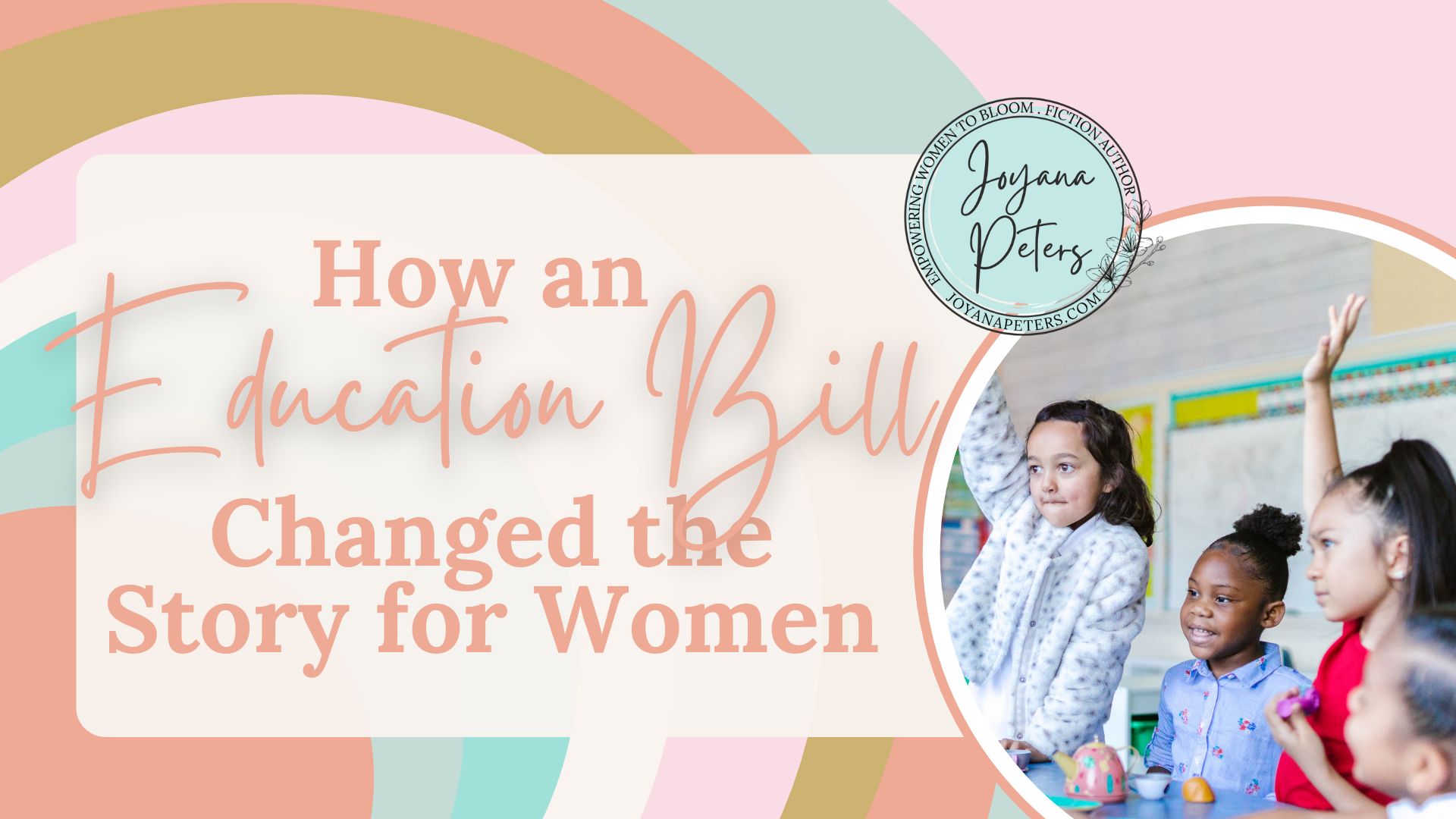
Do you have women in your family who have gone to college? What about any doctors, lawyers or other ceiling busting women? If so, you have Representative Patsy Takemoto Mink to thank.

Fifty-one years ago, Rep. Mink authored a bill and got Congress to pass this landmark piece of legislation. The Title IX of Education Amendments of 1972 prohibits discrimination on the basis of gender in educational institutions and programs that receive federal funding. 

Education Reform

This legislation was groundbreaking for a number of reasons. For the first time women were entitled to an equal education on every level. No more could colleges turn away women from entering particular programs of study!

It also paved the way for sex equity in school sports and other school sponsored extracurricular activities. 

Ultimately, The bill was renamed the Patsy Takemoto Mink Equal Opportunity in Education Act in 2002 to honor her contributions to civil rights, and economic and social justice.

An interview with Rep. Mink in 2002 shared her personal motivations for authoring the bill.

โ€œI have a very personal connection with Title IX because while I was wanting to go to medical school and I had written to a dozen or more medical schools to seek entry, each one of them turned me down by saying that they did not admit women to their schools. It came to me as quite a shock that in America it was not a person’s grade, aptitude, tests, recommendations that got the person into the careers of their choice, but that it had to do with one’s gender.โ€

Luckily, we have come far from those ceiling-inhibiting days. What is something youโ€™re grateful you were able to accomplish as a woman in your lifetime that your mother could not?

Can’t get enough of Joyana Peters? Here are more posts you may enjoy.

2025 Book Log

Find more ways to spoil your inner bookworm!

Check out the Amaryllis Co. Shop, fully stocked with custom designs perfect for every book loving Amaryllis Girl! From shirts, mugs, wine glasses, and more, I have curated a shop with all of my favorites! SHOP HERE! You can also find my collection of bookish merchandise on Etsy.
Merchandise

Privacy Policy

Women Writers Booklist

Women Stories Booklist

As an Amazon Associate I earn from qualifying purchases.

Have a story to tell? Get inspired by these women stories about their journey.

Pen to Paper

This is a booklist that is near and dear to my heart as it combines so many things I am passionate about: empowered women, writers, and historical fiction. This women stories historical fiction booklist includes the obstacles, mysteries, and emotions that encumbered women who were determined to tell a story.

My Name Is Emilia del Valle: A Novel
by Isabel Allende

In San Francisco in 1866, an Irish nun, abandoned following a torrid relationship with a Chilean aristocrat, gives birth to a daughter named Emilia del Valle. Raised by a loving stepfather, Emilia grows into an independent thinker and a self-sufficient young woman.

To pursue her passion for writing, she is willing to defy societal norms. At the age of seventeen, she begins to publish pulp fiction using a manโ€™s pen name. When these fictional worlds can no longer satisfy her sense of adventure, she turns to journalism, convincing an editor at The Daily Examiner to hire her. There she is paired with another talented reporter, Eric Whelan.

Women Stories

Women Stories

Park Avenue Summer by Renรฉe Rosen 

New York City is filled with opportunities for single girls like Alice Weiss, who leaves her small Midwestern town to chase her big-city dreams and unexpectedly lands a job working for the first female editor in chief of Cosmopolitan magazine, Helen Gurley Brown.

For Alice, who wants to be a photographer, it seems like the perfect foot in the door, but nothing could have prepared her for the world she enters. Editors and writers resign on the spot, refusing to work for the woman who wrote the scandalous bestseller Sex and the Single Girl, and confidential memos, article ideas, and cover designs keep finding their way into the wrong hands. When someone tries to pull Alice into a scheme to sabotage her boss, she is more determined than ever to help Helen succeed.

While pressure mounts at the magazine, Alice struggles not to lose sight of her own dreams as sheโ€™s swept up into a glamorous world of five-star dinners, lavish parties, and men who are certainly no good. Because if Helen Gurley Brown has taught her anything, itโ€™s that a woman can demand to have it all.


The Martha’s Vineyard Beach and Book Club by Martha Hall Kelly

The Smith girlsโ€”nineteen-year-old aspiring writer Cadence and sixteen-year-old war-obsessed Briarโ€”are faced with the impossible task of holding their failing family farm together during World War II as the U.S. Army arrives on Marthaโ€™s Vineyard. When Briar spots German U-boats lurking off the islandโ€™s shores, and Cadence falls into an unlikely romance with a sworn enemy, their quiet lives are officially upended. In an attempt at normalcy, Cadence and her best friend, Bess, start a book club, which grows both in members and influence as they connect with a fabulous New York publisher who could make all of Cadenceโ€™s dreams come true. But all that is put at risk by a mysterious man who washes ashoreโ€”and whispers of a spy in their midst. Who in their tight-knit island community can they trust? Could this little book club change the course of the war . . . before itโ€™s too late?

The Martha's Vineyard Beach and Book Club by Martha Hall Kelly


The Dictionary of Lost Words by Pip Williams

The Dictionary of Lost Words by Pip Williams

Esme is born into a world of words. Motherless and irrepressibly curious, she spends her childhood in the Scriptorium, an Oxford garden shed in which her father and a team of dedicated lexicographers are collecting words for the very first Oxford English Dictionary. Young Esmeโ€™s place is beneath the sorting table, unseen and unheard. One day a slip of paper containing the word bondmaid flutters beneath the table. She rescues the slip and, learning that the word means โ€œslave girl,โ€ begins to collect other words that have been discarded or neglected by the dictionary men.

As she grows up, Esme realizes that words and meanings relating to womenโ€™s and common folksโ€™ experiences often go unrecorded. And so she begins in earnest to search out words for her own dictionary: the Dictionary of Lost Words. To do so she must leave the sheltered world of the university and venture out to meet the people whose words will fill those pages.

Set during the height of the womenโ€™s suffrage movement and with the Great War looming, The Dictionary of Lost Words reveals a lost narrative, hidden between the lines of a history written by men. Inspired by actual events, author Pip Williams has delved into the archives of the Oxford English Dictionary to tell this highly original story. The Dictionary of Lost Words is a delightful, lyrical, and deeply thought-provoking celebration of words and the power of language to shape the world.

I would love to hear who your favorite female author is! Share in the comments. If you enjoyed these here are a few more you may enjoy:

2025 Book Log

Find more ways to spoil your inner bookworm!

Check out the Amaryllis Co. Shop, fully stocked with custom designs perfect for every book loving Amaryllis Girl! From shirts, mugs, wine glasses, and more, I have curated a shop with all of my favorites! SHOP HERE! You can also find my collection of bookish merchandise on Etsy.

Merchandise

Privacy Policy

Female empowerment for our daughters

Take Your Daughter to Work Day- Empowering or Outdated?

As an Amazon Associate I earn from qualifying purchases.

Why was this day created and how has it evolved over time?

Take Your Daughter to Work day began in 1992 by Gloria Steinem as a project of the Ms. Foundation. It was created to show girls that being smart was something to be proud of and not something to hide. By providing girls with real-life models in the workplace, the hope was to offer something for girls to strive to achieve themselves. Gender did not have to hold them back from a desired profession.

Parade Magazine wrote about the program and by 1993 the Take Your Daughter to Work Day Foundation was formed to help expand the program nationally and internationally. 

From Female Empowerment to Breaking Gender Stereotypes

In 2003, the Take Your Daughter to Work Day program expanded to include boys. Many criticized this, wasnโ€™t the point to increase female empowerment? But the Foundation argued the expansion would only make the program stronger. It would allow for the dissolution of gender stereotypes completely. For instance, shouldnโ€™t a boy be told heโ€™s allowed to be a nurse?

Empower Children

Since then the program has continued to evolve. Itโ€™s now an April tradition, with worldwide participation. It purposefully takes place during the school year so educators can incorporate it into their lessons, drawing from real world experiences. There have even been purposeful strides in reaching out to low-income communities to find ways for children there to participate as well.

But are we really empowering our daughters?

All of this is fantastic. And I am grateful for these opportunities and lessons for our next generation of workers. However, I feel it’s important to examine the original intent behind the day and how it has changed over time. I love the idea of breaking gender stereotypes and teaching children they can follow any career path that interests them.

But, I feel the focus needs to change on where we empower our children. If I’m honest, I’m less concerned about my daughter, or my son, for that matter, excelling in the workplace. I know plenty of strong, empowered “girl-boss” friends. They speak up for themselves and are rocking the workplace. However, where I do still see an imbalance is on the home front where they’re desperate to find that elusive work-life balance.

If we examine current society and are honest with ourselves, itโ€™s women who still shoulder the bulk of the burden when it comes to childcare and home management in addition to their jobs. Women are still the default parent who gets the phone call from school. They are usually the one who needs to stay home with a sick child. They carry the bulk of the emotional labor, scheduling dentist appointments, filling out school forms, replacing outgrown clothing, chauffeuring, etc.

Men have stepped up on the home front since women started working. I want to be clear, I see that. My husband does A LOT as do many of my friends’ husbands. However, it’s still a far cry from equal. And much of that is because of societal expectations. Schools still call the mother first when a child is sick. I have friends who have listed their husbands as first to call because their jobs are more flexible, and yet the school still calls them first.

Workplaces are also generally more accommodating for a mother to take off when a child is sick rather than a father. Some men I know even mention unspoken “stigmas” that stop them from asking for time off for parenting responsibilities. This goes back to the continuing need to fight for “paternity leave” when having a new baby. How can men ever equally carry the burden of parenting if their workplaces will not even allow them time at home when their baby is born?

And then there are the traditional gender stereotypes and expectations we allow ourselves to fall into. I teach college and my class recently had an interesting discussion about this topic. We read the article The Men We Carry in our Minds by Scott Russell Sanders. The basic gist of the article is a young male student gets into a debate with a college classmate about who has it harder- Men or Women. Our class discussion about the piece led us in many different directions, but at one point I asked them to raise their hands if a statement was true. Out of a class of 27 Gen Z students, only one had ever had a father take him on a field trip. And none thought their father would have known the name of their pediatrician.

Take Your Daughter to Work Starts at Home

We can most definitely tell our girls they can aim for any career path they want. But they are still seeing their mothers carry an unsustainable workload each day and battling burnout. What is the answer to that? Itโ€™s complicated, I know. But until that balance is shifted, our girls will unfortunately always hit a ceiling.

We have come a long way from the imbalance of parenthood from the past. Again, I applaud that men have made major strides in the division of responsibilities at home and child rearing. But we, as a society, can still do better.So, parents, instead of just taking your child to work. Consider what you model for them each day. Are you demonstrating an imbalanced division of labor in the home? Are you making sure one parent isnโ€™t burning out from an overloaded plate? The daily application they witness are the lessons your children will carry. Empower your daughters to speak up, negotiate in all areas of their lives and thrive.

2025 Book Log

Find more ways to spoil your inner bookworm!

Check out the Amaryllis Co. Shop, fully stocked with custom designs perfect for every book loving Amaryllis Girl! From shirts, mugs, wine glasses, and more, I have curated a shop with all of my favorites! SHOP HERE! You can also find my collection of bookish merchandise on Etsy.

Merchandise

Privacy Policy

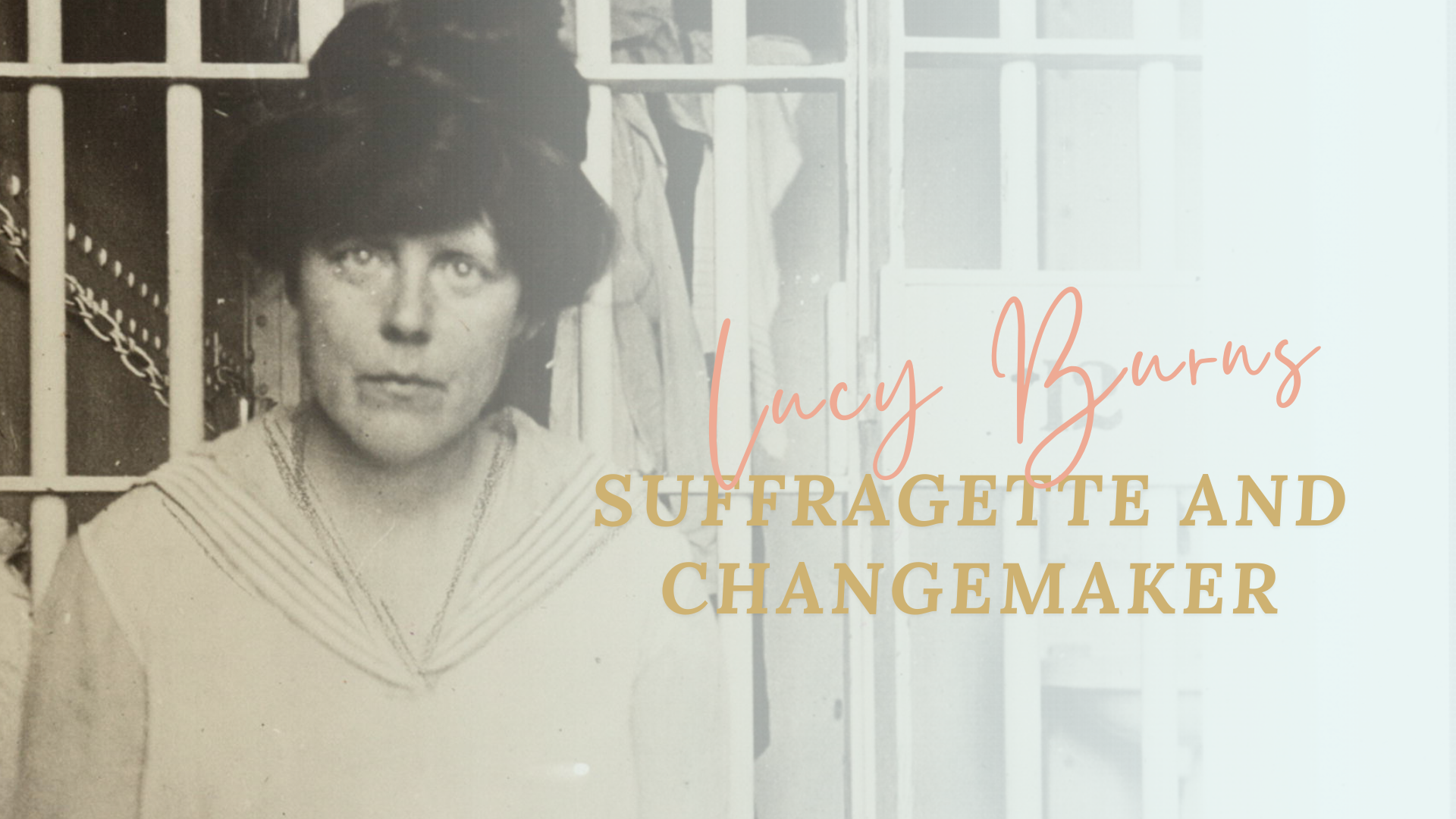
Lucy Burns

Lucy Burns: Suffragette and Changemaker

Lucy Burns- American suffragette and woman’s rights activist.

Inspiration and Friendships

Lucy Burns advocacy efforts began when she spent time in the UK working with Emmeline Pankhurst and the Women’s Social and Political Union.She joined their protests and was arrested for the first time. While there, she also met activist Alice Paul. The two bonded over the inactivity of American suffragettes and their respect for the more militant strategies of the UK suffragette movement.

The Congressional Committee

Upon their return to the U.S, Burns and Paul became the heads of the Congressional Committee of the National American Women Suffrage Association. Both women felt strongly that the best way to ensure woman’s suffrage was to advocate on the federal level for a suffrage amendment.This was a controversial issue in the NAWSA with many willing to settle for guaranteed victories on the state level, while others wanted to “go big or go home” refusing to settle until there was a federal level victory of woman’s suffrage for all.

NAWSA leaders were nervous about approving the Committee or many of its proposed advocacy ideas. They did, at least, approve a suffrage parade which Burns and Paul organized for the day before newly elected Woodrow Wilson’s Inauguration Day. See my other blog post on the March on Washington for further details about this event. NAWSA’s one stipulation was that the Congressional Committee would receive no further funding from NAWSA. This was the beginning of Burns and Paul’s split from NAWSA.

Lucy Burns and The National Woman’s Party

Burns and Paul split from NAWSA and formed their own suffrage group called the Congressional Union. This caused further controversy and divisiveness within the suffrage movement. Many felt threatened by Burns and Paul’s more militant tactics and that they’d alienated political supporters. Eventually Burns and Paul created their own political party called the National Woman’s Party.They felt this was the best way to guarantee direct action in fighting for women’s rights. Their sole goal was the federal right to vote.

In 1917 the NWP led a protest in front of the White House. The women were called the Silent Sentinels and were arrested and sent to the Occoquan Workhouse.

Life in Prison

Burns and Paul led the arrested women in hunger strikes to continue protesting their cause from prison. She led a number of continued protests from prison including circulating a document that defined the status of a political prisoner and alerting the women to their rights. She was eventually put in solitary confinement.

Conditions worsened but the women refused to give up their cause. Eventually, Burns and the women were forced to face what became known as the “Night of Terror”.

The women were beaten and refused medical treatment. Burns continued to call out and reassure the other women despite numerous threats. Eventually guards handcuffed her hands over her head to her cell door and left her that way for the rest of the night. In solidarity, the rest of the suffragette prisoners all held their hands in the same position and stood there with her.

The Aftermath of the “Night of Terror”

After enduring the “Night of Terror” the women conducted another hunger strike for the following three days. The warden eventually moved Burns to another block and ordered her to be force fed. They required five people to hold her down and when she refused to open her mouth, they eventually forced a tube up her nostril.

The Final Push for Suffrage

Burns, Paul and other advocates continued to lobby for votes to pass the federal amendment for woman suffrage. They were once again jailed after another protest at the White House in 1918. After being treated horribly in prison again they were finally released shortly before the next election. They decided their sole focus needed to be on getting anyone in Congress who supported suffrage. This was the first time they focused on candidates outside the Democratic Party. It worked and they cost Democrats their majority in Congress.

By this point tensions between the suffragettes and Wilson were at an all-time high. He realized something needed to be done, especially after all the negative publicity from the protests, arrests and recent election. He requested a special assembly of Congress in May of 1919.

On May 21st the House passed the Susan B. Anthony amendment. The Senate passed it on June 4th. Although the amendment was passed, the suffragettes still had to make sure 3/4 of the states agreed to ratify it. Finally on August 18, 1920, Tennessee became the thirty-sixth state to ratify the Anthony Amendment. The quest for federal suffrage was finally over.

Lucy Burns’ Legacy

Of all the suffragettes from this era, Lucy Burns spent the most time in prison. Once Tennessee ratified the Amendment, Burns was quoted as saying “I don’t want to do anything more. I think we have done all this for women, and we have sacrificed everything we possessed for them, and now let them fight for it now. I am not going to fight anymore.” She retired from political life and spent the rest of her time with her orphaned niece until her death in 1966.

Lucy Burns was named an honoree by the National Women’s History Alliance in 2020. The Lucy Burn Museum also opened to the public in January 2020 at the former site of the Occoquan Workhouse where the “Night of Terror” took place. The museum commemorates Burns and the other suffragettes and their sacrifices in the fight for suffrage.

I am so honored to speak at the Lucy Burns Museum this weekend and honor these women for Women’s History Month. I hope you can join me or stay tuned for the replay of the event soon in my VIP Member section.

Check out more of my Changemaker articles below!

Womens Suffrage Parade 1913

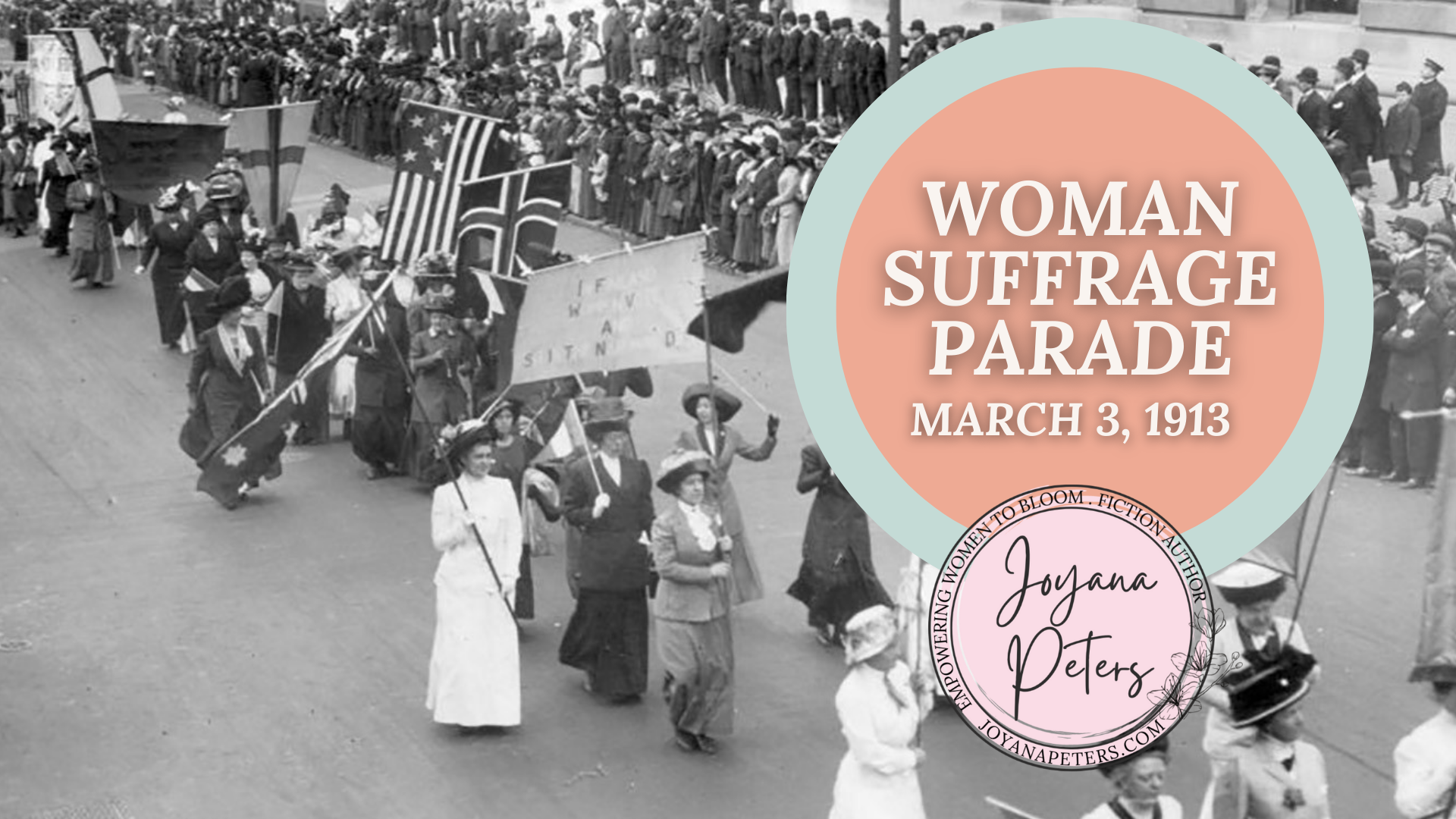
Woman Suffrage Parade on March 3 1913

As an Amazon Associate I earn from qualifying purchases.

“We march today to give evidence to the world of our determination, that this simple act of justice shall be done.” Woman Suffrage March program

Woman Suffrage Parade on March 3 1913

Woman’s Suffrage has a long and difficult history. As we know, there were many who suffered blood, sweat and tears to advocate for woman’s suffrage. Today I’m going to discuss a particular instance in our Woman’s Suffrage history. The Woman Suffrage Parade on March 3 1913 was supposed to be a peaceful march in Washington DC. However, it unfortunately turned into a day of disaster. What happened and why?

women's suffrage parade 1913

The Plan for the Woman Suffrage Parade

On the week of March 4, 1913, everyone gathered for Woodrow Wilson’s Inauguration Day. Wilson’s history was inconsistent when it came to woman’s suffrage. Wilson claimed to be a woman suffrage supporter. However, he believed the states should grant access instead of the federal level. The National American Woman Suffrage Association disagreed.

Lucy Burns and Alice Paul were the newly-appointed chairs of the NAWSA’s Congressional Committee. Paul and Burns wanted more than patchwork woman’s suffrage rights on the state level. They wanted to aim bigger and get the Susan B. Anthony amendment for women’s federal voting rights to pass in Congress. They would do this by shining a spotlight on their cause, making it impossible to ignore.

Paul and Burns carefully planned a parade to demonstrate their cause. They chose to march along Pennsylvania Avenue, the same route Wilson would take the following day for his Inauguration and got thousands of women to march from all across the country.

The Great Demand

Inez Milholland, a famous suffragette, led the parade riding astride a white horse. She wore a white dress and a tiara with the star of hope. “We’re feminists, fighting not just for the vote, but for full equality,” she declared. In addition to Milholland, the parade also featured floats bearing banners for “The Great Demand.”

In keeping with Paul and Burn’s goal of making the parade impossible to ignore, they chose the parade’s slogan carefully. They coined The Great Demand slogan to exemplify that women were more than just demure and gracious. Women were strong and “demanding” access to the equal rights they deserved.

They next divided the parade into sections with orchestrated examples of woman capability. They designed the procession to demonstrate women’s achievements across the nation and how much they already contributed to the country. To do this women marched in their academic regalia from their universities, in uniforms and with others from their professions, and drove their cars. Behind them bands marched and played patriotic music.

Where Things Went Wrong

Few attendees saw the parade in its intended design, however, despite Paul and Burns’ careful planning. A crowd of over 250,000 spectators had turned up to view the parade. But there was little to no crowd control along the route. Spectators abandoned the sidewalks and blocked the route. The marchers tried their best to continue, those in cars or on horseback tried to push back the crowd. But the crowd immediately filled in again. Eventually, the parade stalled.

The marchers found themselves trapped in a crowd of mainly men that turned extremely hostile against them. The crowd jeered and threw things at the marchers. The men grabbed at the marchers, spitting and yelling sexual insults. The women received no assistance from nearby police officers.

Although a few women fled the scene, most were determined to continue and finish the parade. They locked arms and pushed their way through the ambush. Some used their banners and flags as weapons to ward off further attack. They held their ground until U.S. Army troops finally arrived an hour later to clear the street so the parade could continue.

A Key Moment in Suffrage History

Although the parade did not have its “intended” effect, it did still shine a spotlight on the cause. Headlines detailing the disruption and chaos at the parade eclipsed Wilson’s Inauguration coverage. There were also later inquiries in Congress into why there was insufficient crowd control for the event. These investigations kept the parade in the headlines for months to come which brought much needed interest and support to the cause.


I’ll be speaking next week at the Lucy Burns Museum in Lorton, VA. Check out my event listing here to come and join me!

To celebrate this, I’ll be sharing a follow up blog post next week to further delve into Lucy Burns and her personal champion efforts to support the suffrage cause.


Did you enjoy this article? Check out more of my Changemaker History Posts below!

2025 Book Log

Find more ways to spoil your inner bookworm!

Check out the Amaryllis Co. Shop, fully stocked with custom designs perfect for every book loving Amaryllis Girl! From shirts, mugs, wine glasses, and more, I have curated a shop with all of my favorites! SHOP HERE! You can also find my collection of bookish merchandise on Etsy.

Merchandise

Privacy Policy